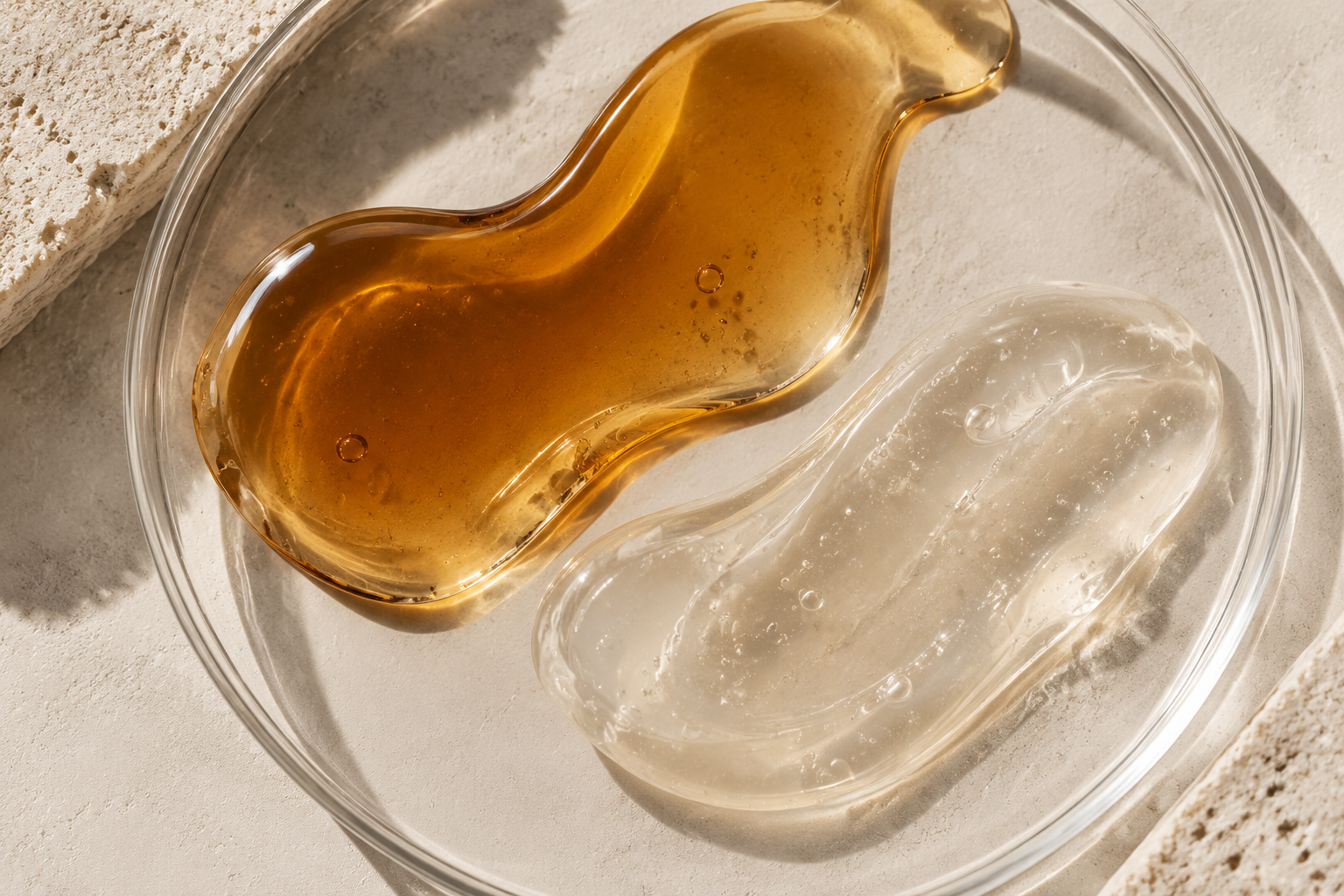
Sterile-filtered Saccharomyces/Xylinum (kombucha) and Oryza sativa (rice) ferments supply postbiotic organic acids buffered at pH 4.2-5.4 alongside sub-3.5 kDa peptides and liberated polyphenols. Unlike unfermented aqueous botanical infusions, fermented filtrates avoid pH drift, chelate trace transition metals through phytic derivatives, and support commensal Staphylococcus epidermidis dominance.
1. Enzymatic Cleavage & The 500-Dalton Permeation Problem
Intact botanical extracts frequently disappoint in rinse-off or leave-on testing because plant polysaccharides, tannin polymers, and bound glycosides sit between 15 kDa and 150 kDa. Under Bos and Meinardi's 500-Dalton rule for passive percutaneous diffusion, bulky macromolecules remain stranded on the outer desquamating corneocytes where they act solely as surface film-formers.
Controlled submerged fermentation with Saccharomyces cerevisiae, Xylinum acetic acid bacteria, or Lactobacillus strains deploys extracellular glycosidases and proteases over 48 to 168 hours. These enzymes strip sugar moieties off flavonoid glycosides and cleave storage proteins into dipeptides, tripeptides, and free L-amino acids that form part of the epidermis's Natural Moisturizing Factor (NMF). Peer-reviewed skin microbiome syntheses confirm that postbiotic lysates modulate barrier antimicrobial peptides without introducing live microbial instability (Molecules, 2025).
2. Saccharomyces/Xylinum (Kombucha) vs. Rice Ferment Filtrate
The Ampersand Essential Skin Defense (ESD) formulation architecture relied on pairing two complementary fermentation substrates rather than a single generic yeast water: black tea kombucha ferment (Saccharomyces/Xylinum/Black Tea Ferment) and fermented rice filtrate (Oryza Sativa / Rice Ferment Filtrate).
Black tea symbiosis generates glucuronic acid, gluconic acid, and catechins freed from gallate complexes, conferring non-enzymatic anti-glycation activity against advanced glycation end-products (AGEs) in dermal collagen. In contrast, Aspergillus oryzae and Saccharomyces rice fermentation enriches inositol, kojic-related organic acids, and ferulic acid derivatives that gently brighten uneven tone while lowering transepidermal water loss (TEWL), as documented in recent rice-ceramide barrier evaluations (Cureus, 2026).
| Ferment Filtrate | Microbial Consortium | Key Postbiotic Metabolites | Native pH | Primary Epidermal Role |
|---|---|---|---|---|
| Black Tea Kombucha Ferment | Saccharomyces + Gluconacetobacter xylinus | Glucuronic acid, acetic/lactic buffer, freed tea polyphenols | 3.8 - 4.6 | Anti-glycation & oxidative lipid shielding |
| Oryza Sativa (Rice) Filtrate | Saccharomyces / Aspergillus oryzae | Inositol, free amino acids, ferulic & phytic derivatives | 4.4 - 5.3 | NMF hydration, gentle tyrosinase modulation |
| Bifida / Lactobacillus Lysate | Bifidobacterium / Lactobacillus | Peptidoglycan fragments, L-lactic acid, bacteriocins | 4.3 - 5.1 | TLR-2 barrier tolerance & erythema dampening |
| Fermented Cloudberry Fraction | Yeast-assisted phenolic cleavage | Free ellagic acid, gallic aglycones, ascorbic cofactors | 4.1 - 4.9 | MMP-1 collagenase inhibition & radical scavenging |
3. Arctic Cloudberry (Rubus chamaemorus) & Phenolic Bioavailability
Wild Nordic cloudberry (Rubus chamaemorus) thrives under continuous sub-arctic daylight, accumulating exceptionally high concentrations of ellagitannins (up to 300 mg per 100 g fresh fruit) alongside carotenoids and alpha-tocopherol. In raw aqueous juice, large ellagitannin oligomers like sanguiin H-6 oxidize rapidly and exhibit limited penetration.
When incorporated into a fermented phospholipid vehicle alongside resveratrol and carnitine HCl, enzymatic cleavage releases monomeric ellagic acid and smaller phenolic acids. Ellagic acid exhibits direct iron- and copper-chelating properties, curbing Fenton-reaction hydroxyl radical generation inside UV-exposed keratinocytes. Furthermore, cloudberry seed lipids supply linoleic (omega-6) and alpha-linolenic (omega-3) fatty acids that integrate cleanly with endogenous ceramides.
4. Preservative Reality: Postbiotic Filtrates vs. Live Probiotics
A common consumer misconception assumes probiotic skincare contains viable Lactobacillus colony-forming units inside a dropper bottle. Under ISO 11930 cosmetic microbiological challenge testing, any water-based serum capable of sustaining live bacterial growth will fail preservation limits and risk opportunistic contamination by Pseudomonas aeruginosa or Candida once opened.
Instead, validated cosmetic fermentation uses heat inactivation followed by 0.2-micron sterile filtration. What enters the final serum is a sterile, cell-free supernatant rich in organic acids, amino acids, and cell-wall muramyl peptides. These postbiotic signals communicate with keratinocyte Toll-like receptors to upregulate filaggrin and beta-defensin expression without risking bacterial overgrowth on compromised skin.
5. Organic Acid Buffering & Chelation Capacity in Leave-On Vehicles
Beyond molecular weight reduction, fermented filtrates act as weak conjugate acid-base buffers across pH 4.2 to 5.4. In a typical yeast-tea or rice-ferment supernatant, L-lactic acid (pKa 3.86), gluconic acid (pKa 3.7), and acetic acid (pKa 4.76) stabilize the emulsion against alkaline drift caused by tap-water mineral residues left on damp skin after cleansing.
Simultaneously, endogenous phytic acid liberated from rice bran fermentation chelates divalent iron and copper cations. Because unbound transition metals catalyze lipid peroxidation in unsaturated botanical oils and accelerate polyphenol browning, pairing fermented rice filtrate with sodium phytate or GLDA meaningfully extends serum color stability without raising sting on reactive skin.
6. Technical Questions on Ferment Layering
Do fermented skincare filtrates contain live probiotic bacteria?
Commercial leave-on serums use sterile-filtered lysates and postbiotic filtrates rather than live cultures, preventing preservative failure while delivering bioactive peptides and organic acids.
Reference: ISO 11930 Preservative Efficacy & Molecules 2025 Postbiotic Review
How does fermentation change Arctic cloudberry and rice extracts?
Microbial enzymes hydrolyze bound glycosides into free ellagic acid, ferulic fractions, and low-molecular-weight amino acids under 3.5 kDa, improving bioavailability across the upper stratum corneum.
Reference: Cureus 2026 Oryza Barrier Analysis & ESD Archive Records
Historical Citation Archive (2018-2024)
All You Need to Know About Fermented Skincare
Preserved technical summary of the October 2019 Ampersand editorial monograph detailing how fermentation preserves botanical bioactivity, lowers vehicle pH into the acid-mantle zone, and enhances small-molecule absorption compared with unfermented extracts.
View 2019 Original Premise & 2026 Formulation Update
The 2019 article explained the transition of traditional lacto-fermentation from nutrition into Korean and clinical cosmetic chemistry, emphasizing three benefits: stronger barrier protection via fermentation-derived antioxidants, improved ingredient bioavailability, and microbiome-friendly pH balance. Today this premise is expanded with quantitative 0.2-micron sterile-filtration metrics and postbiotic organic acid pKa profiles above.
Postbiotic Lysates & Skin Microbiome Equilibrium
Consolidates Ampersand's 2019 microbiome essays explaining why gentle, non-stripping lactic-acid and yeast-ferment serums reinforce commensal flora resilience without introducing live bacterial instability into water-based cosmetics.
Rubus Chamaemorus (Cloudberry) in Essential Skin Defense (ESD)
Preserved ingredient monograph explaining why cold-climate Nordic cloudberry fruit extract served as the core polyphenol anchor inside the ESD proprietary complex, supplying ellagitannins, vitamin E tocopherols, and omega fatty acids for mature and UV-stressed skin.